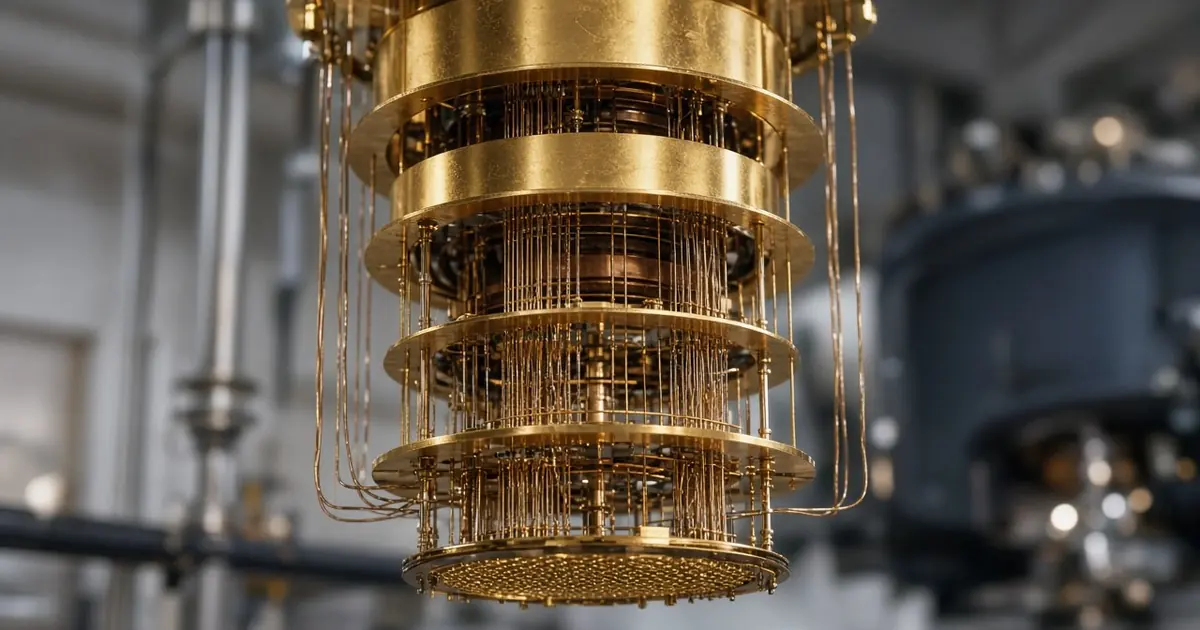
IQM preprint shows a quantum kernel beating classical models on an engineered task at up to 45 qubits
Short answer: Researchers at quantum hardware maker IQM report that a quantum machine learning model running on its noisy processors outperformed a full set of classical models on a classification task designed to favour quantum hardware, at 15, 30 and 45 qubits. They also say plainly that this is not quantum advantage, because a classical simulation of the same circuits matched it.
The work is described in a 12 November IQM blog post and the preprint Engineered Learning Problems on Noisy Quantum Processors by Esteban Payares, Nadia Milazzo, Ghada Ben Slama and Thomas Cope. The experiments ran on IQM Emerald (54 qubits) and IQM Garnet (20 qubits) using images of T-shirts and dresses from the Fashion-MNIST dataset. One quantum run, the referee, relabels the images so quantum kernels predict them well and classical similarity measures do not; a second run on separate hardware, the challenger, then has to predict those labels, as do 11 classical models.
At 15 qubits with shallow circuits, IQM says the quantum challenger labelled 81% of test images correctly against 51% for the best classical model. At the deepest 15-qubit setting the gap shrank to 68% versus 64%, which was not statistically significant. At 30 and 45 qubits the gap stayed between 17 and 28 points at every depth tested.
The team also tested error mitigation on the deepest 15-qubit case. Zero-noise extrapolation and IQM's adaptive Pauli twirling both restored a significant gap, of 14 and 17 points. But the authors found most of the zero-noise extrapolation gain came from making the referee's labels harder for classical models rather than from better quantum computation, a caution they say a noise-free reference can expose.
The key limit is classical simulation. For the largest run, 45 qubits at the deepest setting, the authors simulated the circuits with matrix product states in under 20 seconds per circuit and reached 72% accuracy, against 73% for the quantum challenger. The preprint abstract calls the task artificial and says beating state-of-the-art simulation remains the main challenge.