NIST pins down where you are with entangled photons, closing loopholes in quantum position checks
Short answer: Researchers at the US National Institute of Standards and Technology (NIST) and their collaborators have used entangled photons to check that a person is where they say they are, in what physicist Krister Shalm calls "the first complete demonstration" of quantum position verification. NIST announced the result on 18 November, and the team reported it in Nature this week.
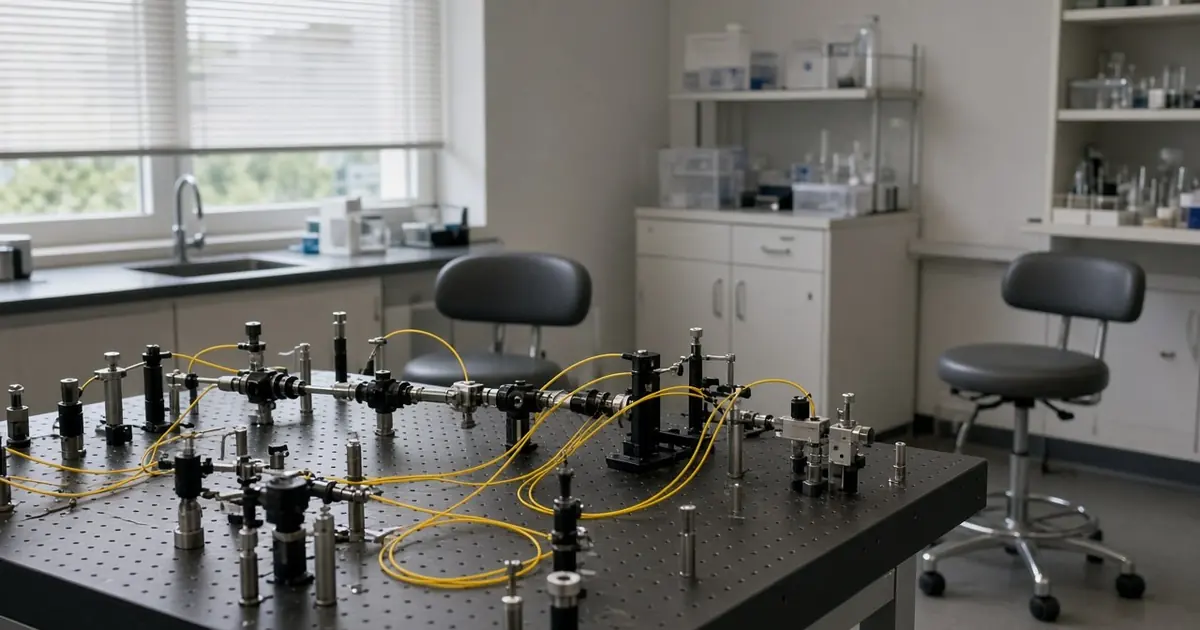
The method uses two trusted verifiers and one prover. On the NIST campus in Boulder, Colorado, the team built two verifier stations 195 metres apart, linked by electrical cables and optical fibre, with the prover's claimed location between them. One verifier creates a pair of entangled photons, keeps one and sends the other to the prover. Both verifiers then send random numbers timed to reach the prover's claimed location at the same moment. The prover uses those numbers to decide how to measure the photon's polarisation and sends the result back.
Two physical rules do the checking. Because nothing travels faster than light, a prover who is somewhere else takes too long to answer. And because the verifiers run a loophole-free Bell test on millions of rounds over a few minutes, a cheater cannot copy the quantum information to accomplices or answer early without the correlations breaking down. According to NIST, earlier schemes left loopholes that impostors could exploit, and this experiment closes them.
NIST suggests uses such as stopping remote attackers from sending commands to power grids or water plants, protecting medical records, and blocking unauthorised trades. Study collaborator Scott Glancy cautions that real-world use "may be more than a decade away", because it needs high-fidelity quantum networks that can share entangled photons between, for example, a customer and their bank. The Quantum Insider carries the full release.
For readers following post-quantum security, this is a different tool from the new encryption standards we track, such as NIST's 2030 to 2035 public-key transition. It checks where a party is, not just who holds a key.