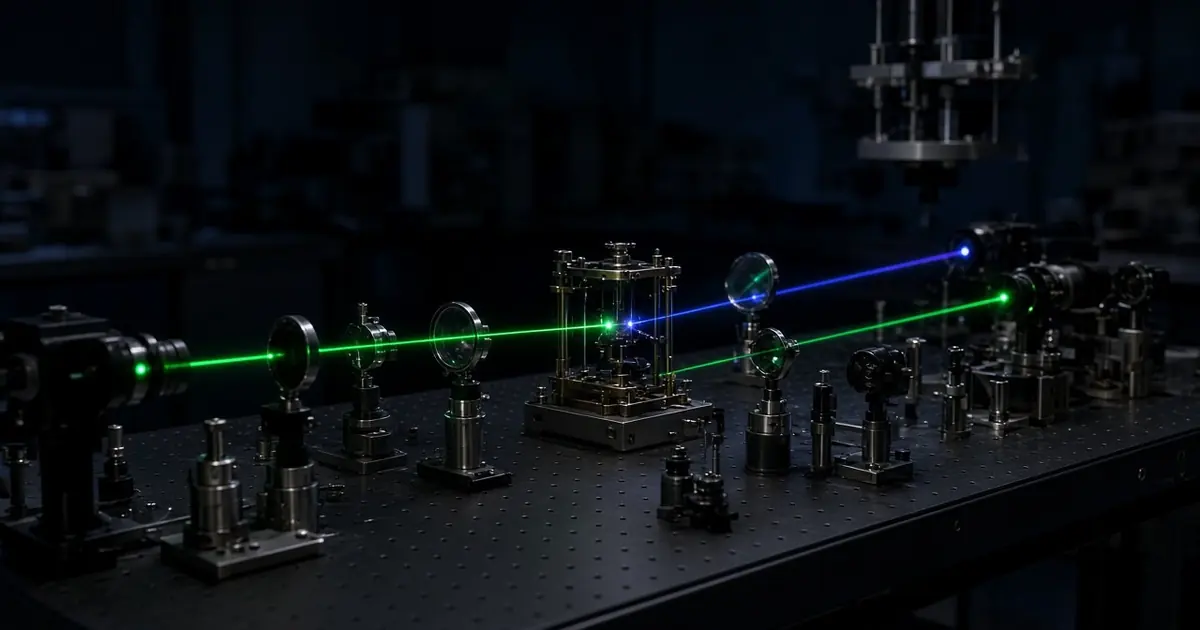
Oxford trapped-ion experiment shows Aharonov-Bohm interference in a lattice gauge theory loop
Researchers at the University of Oxford have used trapped ions to simulate the Aharonov-Bohm effect in a lattice gauge theory, according to a Nature Physics study described by Phys.org on November 7. The experiment built a quasi-two-dimensional loop so the team could see how magnetic flux affects a moving particle. Most earlier simulations of the simplest version of the theory could not show this.
Why loops matter
Lattice gauge theories model space as a grid, with matter at the sites and gauge fields on the links between them. In the simplest Z2 version, each link holds one of two values: a field line is either present or absent. Phys.org notes that Z2 theories are used to describe quantum spin liquids and high-temperature superconductors and are relevant to topological quantum error correction.
Most quantum simulations of Z2 theories have been one-dimensional, where links cannot form closed loops and flux effects cannot appear. Some two-dimensional experiments removed the matter fields, so they could not show how charges and fields affect each other.
Ions doing double duty
The Oxford team used a hybrid approach. Two electronic levels of a strontium ion served as a qubit representing the gauge field on a link, while the ion's vibrations stored matter. A single phonon represented one matter particle. Laser-driven forces made the phonon hop between sites, and each hop flipped the link's field line, tying the particle's motion to the gauge field.
"The advantage is that matter fields can be stored much more efficiently in the vibrational modes," said first author Sebastian Saner.
What they saw
With one ion and one link, the particle tunneled back and forth while the field line switched on and off, which is consistent with the Z2 version of Gauss's law. When the researchers added an energy cost for creating a field line, tunneling became faster but smaller. They describe this suppression as a precursor to confinement.
Adding a second ion created a second link, so the particle had two paths around a loop. Entangling the two link qubits encoded the flux:
- Zero flux: both paths added up, and the particle tunneled twice as fast as on a single link. - Nonzero flux (a "vison"): the paths canceled out, and the particle stayed where it started.
The flux stayed constant apart from slow decay due to decoherence. Numerical simulations that included known noise sources matched the data.
Next steps
Saner said the single loop "can easily be solved using classical computers," but that "even a relatively modest increase in lattice size could make the problem very difficult, if not impossible in practice" to simulate classically. The team also wants to extend the approach to Zn gauge theories with more field values.