Cornell chip cools a trapped ion close to its ground state in about 150 microseconds
Short answer: Researchers at Cornell say a chip that delivers a carefully shaped pattern of laser light can cool a trapped ion's motion close to its quantum ground state in about 150 microseconds, against roughly 500 microseconds with a conventional laser arrangement, a roughly threefold speed-up also highlighted by Interesting Engineering. The work was published on 9 November in PRX Quantum and announced by the university on 12 November.
Trapped-ion quantum computers hold individual charged atoms in electromagnetic fields, and any leftover motion can spoil calculations, so the ions must be cooled again and again. According to the Cornell Chronicle, that cooling can take up a large share of a machine's running time. "Cooling operations, particularly to near the quantum ground state, end up being a major bottleneck in leading systems," said Karan Mehta, the assistant professor of electrical and computer engineering who led the work.
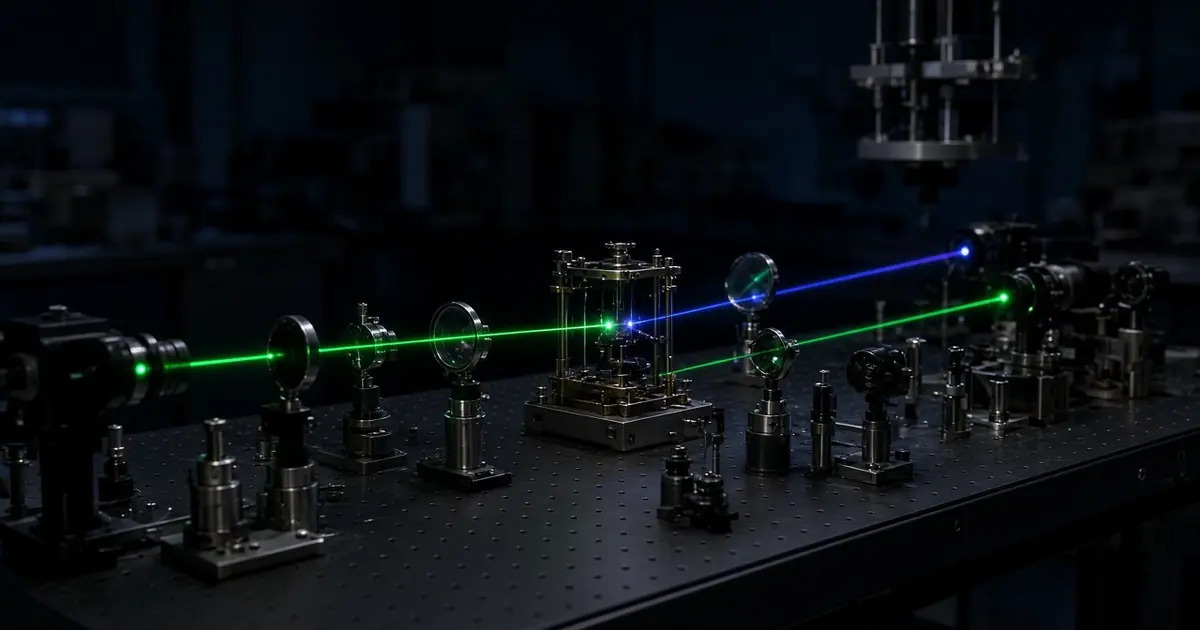
The team sent two counter-propagating beams through photonic components built into the trap chip, creating a standing wave of bright and dark regions. Placing a calcium ion at a point of minimum intensity let them remove energy from its motion while suppressing interactions that would otherwise heat it, the university says. The method is a form of electromagnetically induced transparency cooling.
Two further results stand out in the release. The technique cooled all three measured modes of the ion's motion at the same time, across a frequency range of about 5 megahertz, where conventional approaches often need separate cooling steps for each direction. The researchers also report cooling below the conventional Doppler limit, confirming a long-standing theoretical prediction.
The chips were made commercially in the Netherlands through a collaboration with ETH Zurich, and were packaged to handle wavelengths from ultraviolet to near-infrared while running at cryogenic temperatures. Doctoral students Zhenzhong Xing and Hamim Mahmud Rivy are the co-first authors.
The experiment used a single ion, so the speed-up has not yet been shown in a full processor. The Cornell team argues the approach applies to larger trapped-ion machines, and integrated optics of this kind are one of the routes several groups are pursuing to scale ion traps to many more qubits.