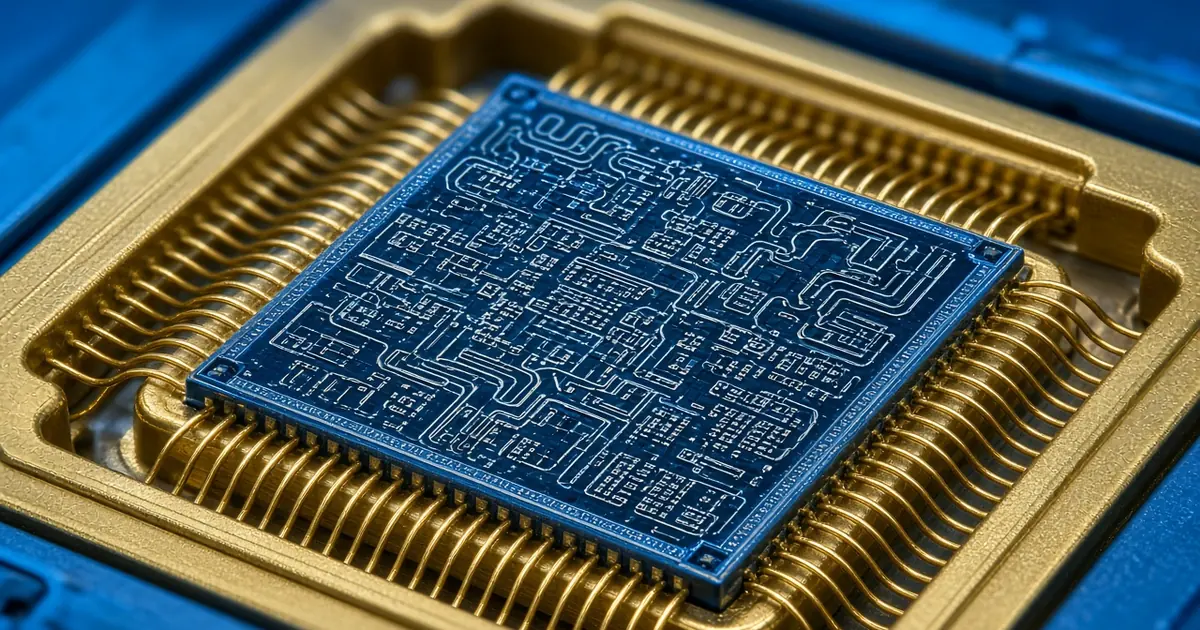
What has Google Quantum AI published about Willow?
Short answer: Google Quantum AI is the quantum computing group Hartmut Neven says he founded in 2012 inside Google Research. Its processor Willow has 105 qubits, according to Google's 9 December 2024 announcement (that page says it was last updated 12 June 2025). The same post is where Google sets out Willow's error-correction and benchmark claims. Those blog figures were checked again on 20 November 2026.
What Google says the lab is
Neven writes that the aim was a useful, large-scale quantum computer, and that Willow was made in a Santa Barbara facility built for chips of this kind. He also places the group inside Google Research. This page has no independent visit to that lab. The description is Google's.
What Google says Willow did
The announcement says the team ran memories on grids of 3 by 3, 5 by 5 and 7 by 7 encoded qubits, and that each step up cut the error rate in half. Google calls that below threshold: the error rate fell as the code grew, which is the behaviour error correction needs, rather than extra qubits only adding noise. Google also says the encoded groups lasted longer than the best single physical qubits on the chip, a comparison it calls beyond breakeven. What a logical qubit is explains why that comparison is the one that matters, and quantum error correction basics defines the threshold. The sharper per-cycle percentages in those explainers come from the group's Nature paper, not from the blog post opened for this page, so they are not repeated here.
Google says Willow's T1 times, how long a qubit holds an excitation, are approaching 100 microseconds, about five times its previous chips. That, too, is Google's figure from the same post.
On random circuit sampling, Google says Willow finished a run in under five minutes that would take the Frontier supercomputer 10 to the power of 25 years. Google says the estimate gives Frontier full use of its disks, which Google itself calls a generous assumption, and that classical computers should be expected to get better at the same test. Google also says the test has no known commercial use. The post's own next aim is a calculation that is both out of reach for classical computers and useful for something. A 105-qubit count and a large sampling gap are not that result.
Two later Willow reports on this site
Our 15 October report covers Google's claim that magic state cultivation ran on Willow. Our 20 November story, citing Google's research blog and a Science paper, reports Google's figure of 98.3 percent of rounds won on the magic square game against a classical ceiling of 88.9 percent, using up to 105 qubits. That story says Google does not present the result as useful quantum advantage. The 98.3 percent figure was not re-opened in the Science PDF for this hub. It is carried from that sourced story.
Where a government list puts the group
DARPA's Quantum Benchmarking Initiative page, whose performer list is marked current as of 8 October 2026, places Google Quantum AI in Stage A, on superconducting transmon qubits. On that page Stage A is the step where a team describes a utility-scale concept, and the award ceiling listed for it is $1 million. The same list puts IonQ, IBM, Atom Computing, Diraq, Microsoft and PsiQuantum in Stage C, where the ceiling listed is $300 million. Quantinuum is in Stage B. DARPA says a company is listed only while it has an active scope of work, and that the list is not updated in real time, so Stage A on that date is not a published verdict that Google cannot go further.
The cards further down also include Google DeepMind items, because this hub collects stories that mention Google. The Lean 4 algorithm note and the 1024-bit RSA note are DeepMind write-ups, not Willow chip benchmarks.
Last verified 20 November 2026 against Google's Willow announcement and DARPA's program page. The November contextuality percentage is as reported in our story from that day.
The American Physical Society has named Google Quantum AI's Ryan Babbush the 2027 recipient of the Rolf Landauer and Charles H. Bennett Award in Quantum Computing, for work on quantum algorithms and circuit compilation.
Google Quantum AI says its Willow processor won the magic square game 98.3% of the time against a classical ceiling of 88.9%, and ran contextuality tests on up to 105 qubits. The work is on the cover of Science.
Quantum Computing Report said a 10 November paper describes Gemini agents in Lean 4 that synthesised and machine-checked quantum programs, with reported spacetime-cost reductions on several scientific benchmarks.
Google DeepMind said on 6 November 2026 that human-guided AI agents uncovered two major weaknesses in legacy 1024-bit RSA cryptosystems, while stressing that modern 2048-bit systems remain safe from those specific exploits.
Google Quantum AI says magic state cultivation worked on its Willow chip, cutting errors about 40-fold and yielding T-states at 99.99% logical fidelity.